
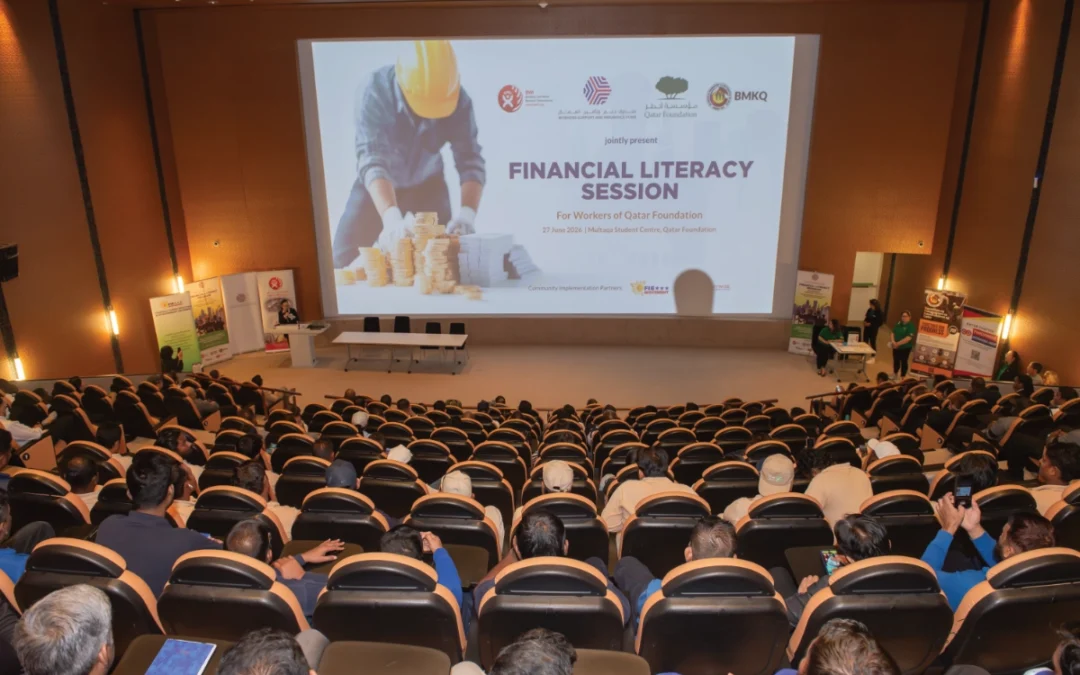
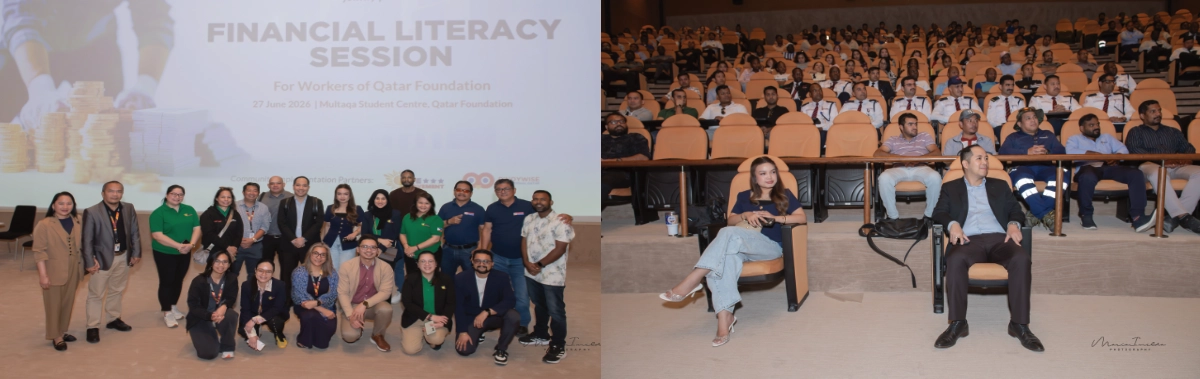
Doha, Qatar. A financial literacy session held on June 27 at Qatar Foundation’s Multaqa Student Center trained 196 workers on practical money management, responsible financial behavior, and scam awareness. The program was jointly organized by the Workers Support and Insurance Fund (WSIF), Qatar Foundation (QF), and Building and Wood Workers’ International (BWI), with facilitation from BMKQ, OFIE‑M, and PinoyWISE Qatar.
The two‑hour session focused on strengthening workers’ understanding of daily budgeting, building consistent monthly savings, and recognizing fraudulent schemes that commonly target migrant communities. Participants—representing maintenance, hospitality, welfare, security, and healthcare roles—came from nine Asian and African nationalities, reflecting Qatar Foundation’s diverse workforce.
Mr. Bimal Subaide of BWI delivered the safety induction ahead of the session, setting the tone for a structured and secure learning environment.
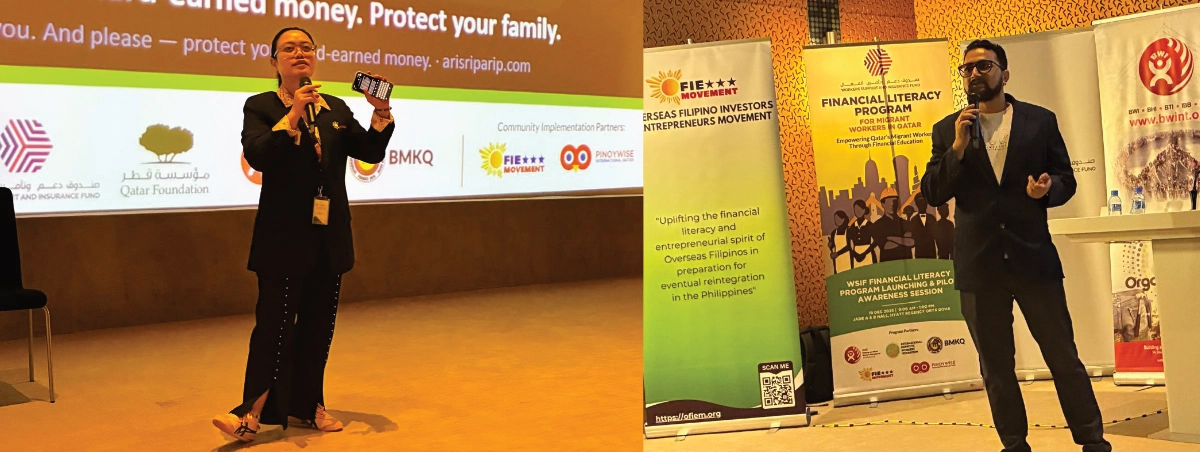
Opening the program, Mr. John Fabia of Qatar Foundation Workers Welfare welcomed all participants and expressed appreciation to the initiative’s partner organizations. He emphasized that the training reflects Qatar Foundation’s ongoing commitment to workers’ welfare, noting that the foundation continues to conduct awareness sessions, skills trainings, and capacity‑building activities to equip its workforce.
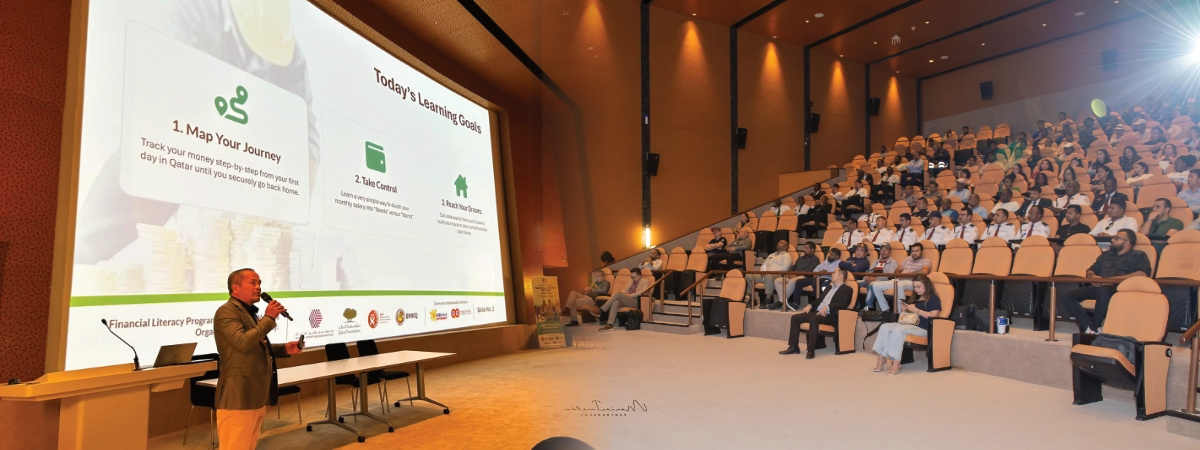
Engr. Ressie Fos led the opening module by walking participants through the financial journey of migrant workers, highlighting the realities that shape how workers earn, spend, and save. He placed strong emphasis on smart, disciplined, and intentional spending, noting that for most workers, the idea of “earning more to save more” is rarely practical or within their control.
Instead, he underscored a more achievable path: managing expenses deliberately. By controlling day‑to‑day spending, workers can secure fixed and predictable savings at the end of each month, regardless of income level. Engr. Fos explained that this shift—from chasing higher income to mastering personal budgeting—empowers workers to build financial stability using tools already within their reach.
The second module, delivered by Mr. Aris Riparip, deepened the discussion by shifting from budgeting to safe financial practices and scam prevention, grounding the lesson in real‑world risks faced by migrant workers. His session featured actual fraud cases shared by participants and a role‑play demonstration of a scam phone call, giving workers a clear picture of how deceptive schemes operate.
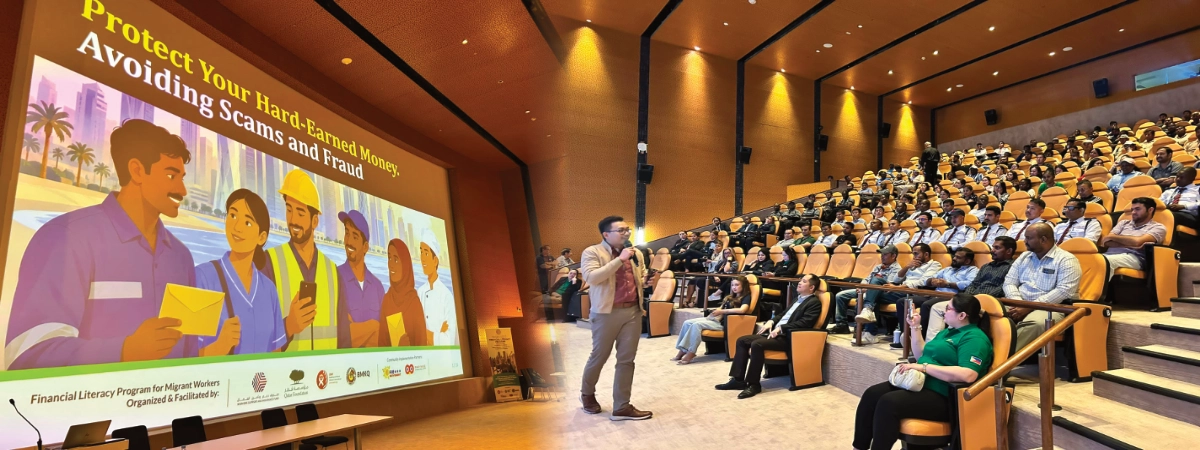
Mr. Riparip positioned his module as a natural continuation of the first: once workers begin saving consistently and feel motivated to grow their money, they often become more curious—and more vulnerable—to offers promising quick returns. He explained that this is precisely the stage where investment scams typically strike, targeting workers who have predictable monthly incomes and newly accumulated savings.
He stressed that migrant workers remain among the top targets of scammers, and that a single fraudulent scheme can wipe out months or even years of hard‑earned savings. By understanding how scams are structured and how scammers manipulate trust, workers can better protect the financial progress they have worked hard to build.
Ms. May Shael Laguindab skillfully hosted the session, providing a clear sense of direction from start to finish. She guided the flow of discussions, ensured smooth transitions between modules, and kept participants engaged throughout the program. Her facilitation helped maintain the session’s momentum, reinforcing key messages and creating an environment where workers felt comfortable sharing experiences and asking questions.
Organizers reported strong and sustained engagement throughout the program, with evaluation results reflecting overwhelmingly positive feedback from participants. Workers described the topics as highly relevant to their daily financial realities, commended the clarity and practicality of both speakers, and expressed interest in more interactive learning tools such as videos, case studies, and scenario‑based demonstrations. Many attendees also requested future sessions on digital safety, labor rights, mental health, first aid, and heat‑stress awareness, signaling a growing appetite for broader worker‑focused education.
Despite minor logistical challenges, the initiative successfully met its core objectives of strengthening financial awareness and equipping workers with practical tools to safeguard their earnings. Organizers noted that the session served as an effective introductory program, laying the groundwork for more comprehensive training in the future and affirming their openness to expanding similar worker‑support initiatives across Qatar Foundation.
Photos by: Imelda Enrille & Mavs Ardiza